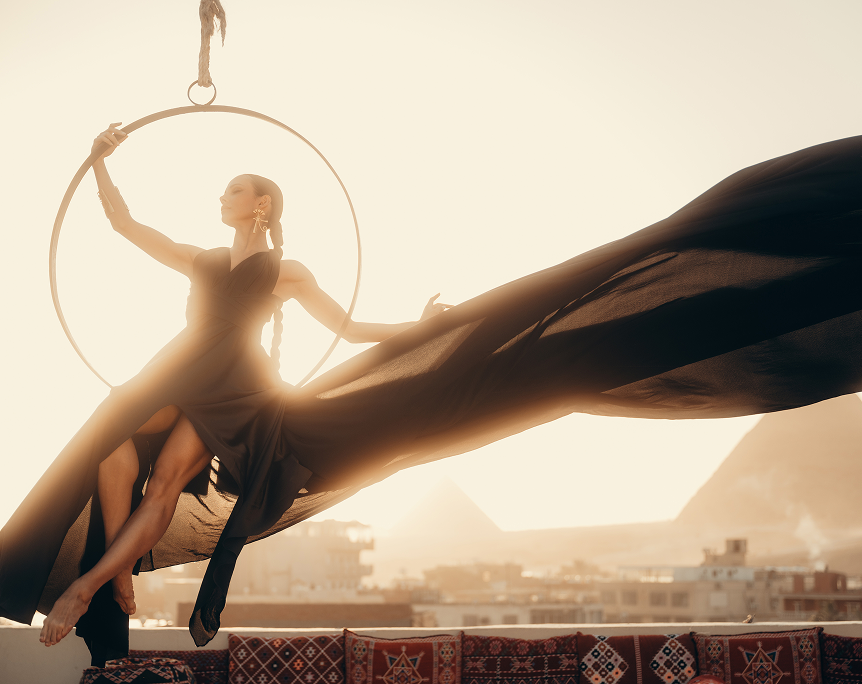
One year after its official opening, the Grand Egyptian Museum is preparing to host Gala de Danza’s first edition in the Middle East and North Africa. On November 5, international figures from ballet, contemporary dance, music, and the performing arts will share the stage with 100 young Egyptian artists in a celebration that proposes a different way of thinking about heritage: what we inherit is not only meant to be preserved. It can also become the starting point for something new.
There is something extraordinary about imagining dance inside a museum built to safeguard thousands of years of history.
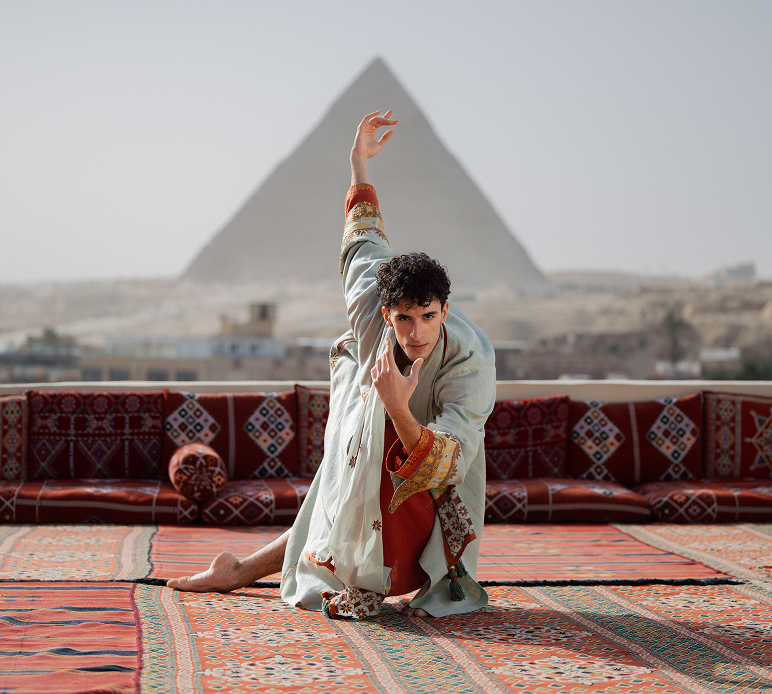
An archaeological object exists to endure. Dance, by contrast, exists only as it happens. A movement appears and disappears within seconds; a collection can survive entire civilizations. On November 5, these two ways of experiencing time will meet at the foot of the Pyramids of Giza.
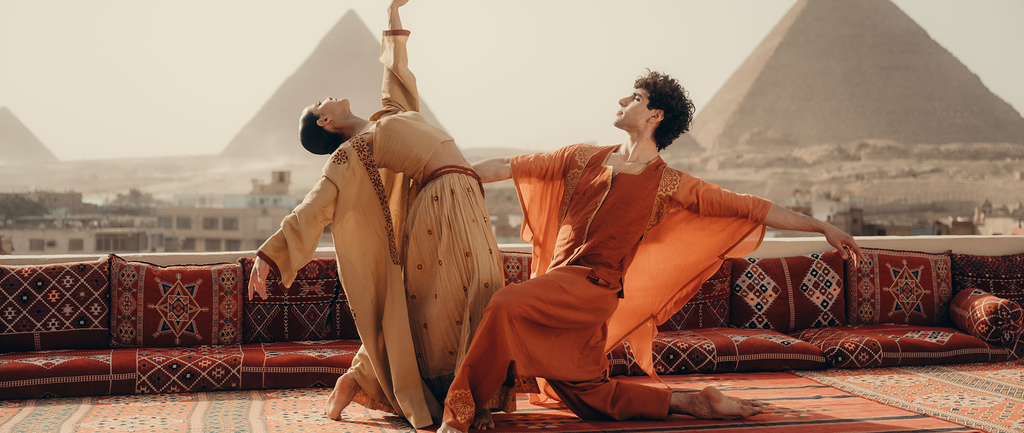
Gala de Danza will arrive at the Grand Egyptian Museum (GEM) for its ninth edition and its first presentation in the Middle East and North Africa. The program will bring together ballet, contemporary dance, music, and immersive performance within a setting whose own history makes the choice of venue far more than an aesthetic decision.
The occasion also arrives at a symbolic moment. In November 2025, the GEM officially opened all of its galleries. One year later, the institution is marking that anniversary by exploring a different possibility: that a museum devoted to preserving the past can also become a place where contemporary culture is created.
Gala de Danza will arrive at the Grand Egyptian Museum (GEM) for its ninth edition, marking its first-ever presentation in the Middle East and North Africa.
A Museum That Refuses to Stand Still
“History is not only what we preserve, it is what we inspire,” said Dr. Ahmed Ghoneim, director general of the Grand Egyptian Museum, during the presentation of the collaboration.
The statement captures an ambition that extends far beyond a single evening of performance.
The GEM was conceived to preserve, study, and exhibit one of the great collections devoted to ancient Egyptian civilization. But its cultural project also raises another question: what role can an institution built around memory play in the culture we are still creating?
For Ghoneim, part of the answer lies in making the museum a living space, one capable of connecting generations and allowing Egypt’s heritage to enter into conversation with contemporary forms of expression. Gala de Danza is part of that ambition, as well as the GEM’s broader aspiration to establish itself as an international center for culture and heritage.
Dance becomes particularly powerful within that conversation. It does not need to physically endure in order to leave a trace. It exists in the moment and, once the music ends, survives only in the memory of those who witnessed it.
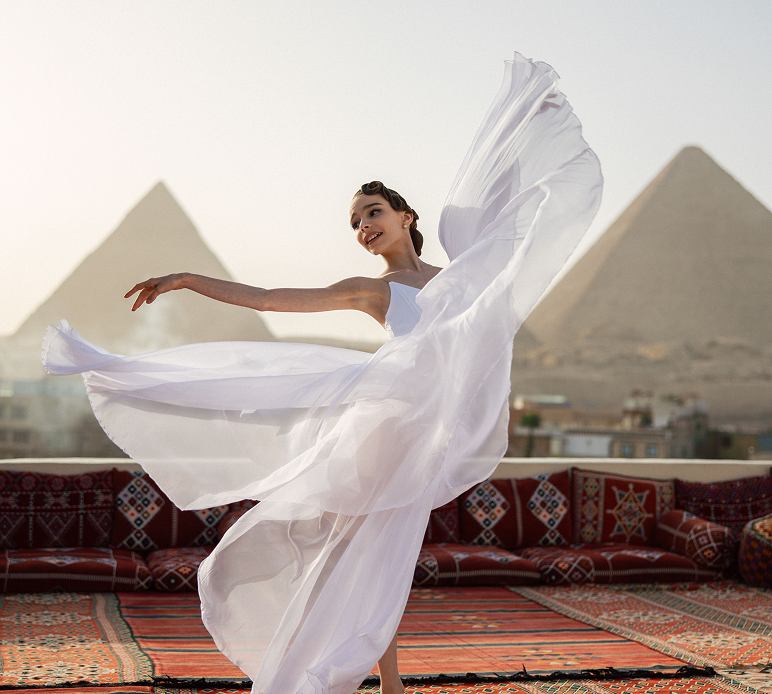
Permanence and the Ephemeral
Behind Gala de Danza is Christina Lyon, who founded the platform in 2013 with the intention of bringing dancers, musicians, and creators together in settings capable of transforming the experience of performance.
For Lyon, the Grand Egyptian Museum offers precisely that possibility: a place where, in her words, “the stillness of ancient collections meets the energy of live performance.”
The contradiction is part of its beauty. The objects housed within the museum have survived for millennia. Dance disappears almost at the very moment it happens. One represents our ability to preserve; the other, our need to continue creating even when we know what we create cannot remain. For one evening, the two will occupy the same space.

From London, St. Petersburg and San Francisco to Giza
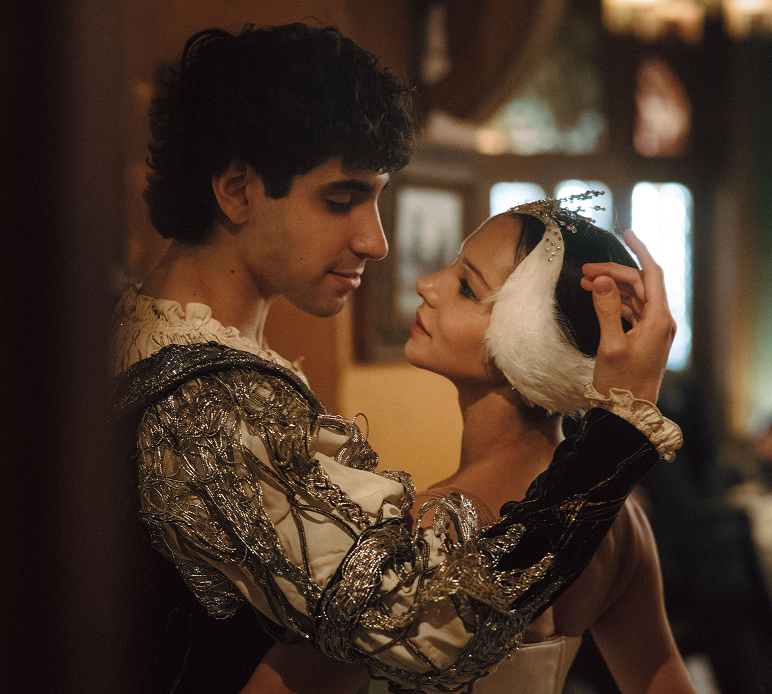
The program will bring together artists from different disciplines and traditions. Among those announced are César Corrales and Francesca Hayward, principal dancers of The Royal Ballet; Maria Khoreva of the Mariinsky Ballet; Bakhtiyar Adamzhan, principal dancer of Astana Opera; and Madeline Woo, principal dancer of San Francisco Ballet.
They will be joined by Sawsan Albahiti, Saudi Arabia’s first opera singer; William Close and his Earth Harp; France’s MAGICLAB; classical saxophonist Valentin Kovalev; and British contemporary dance company Rambert.
But the evening will not simply transport existing repertoire into an extraordinary setting. Part of the program is being created specifically for the occasion.
Egyptian-born dancer Luca Abdel-Nour will choreograph a work for Dutch National Ballet principal Yuanyuan Zhang. Brazilian choreographer Juliano Nunes will develop a new piece with dancers from USC Kaufman, while Josie Walsh of BalletRED will present a new artistic work.
That detail changes the nature of the encounter. Giza is not simply serving as the backdrop for work created elsewhere. It is also becoming the place where something new begins.
Legacy is not only about preserving what we inherit. It is also about deciding what we do with it next.
100 Artists and a Generation Just Beginning
Among all the international names announced, perhaps one of the evening’s most meaningful gestures will not come from a major company.
One hundred girls and teenage artists from local Egyptian schools will share the stage with some of the invited performers.
Their participation introduces another dimension to the idea of heritage.
Passing culture forward does not simply mean teaching a new generation what came before it. It also means giving that generation a place from which to imagine what might come next.
For a young performer, taking part in a production alongside international artists can offer an opportunity to observe different ways of working, encounter new creative possibilities, and recognize herself as part of an artistic community that extends far beyond her immediate surroundings.
On an evening surrounded by objects that have survived for thousands of years, it will be some of its youngest artists who represent what does not yet exist.
What We Do With What We Inherit
The choice of the Grand Egyptian Museum was never merely ornamental.
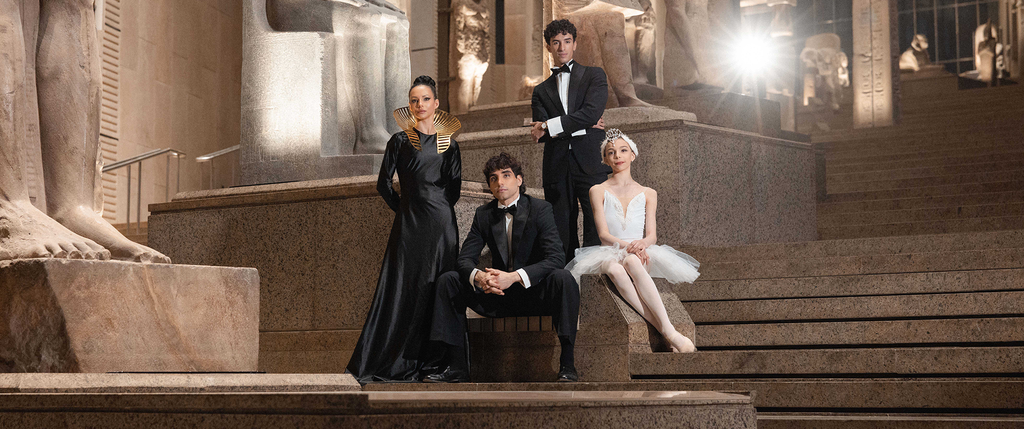
Its architecture, its proximity to the Pyramids of Giza, and the collections it houses are part of the gala’s narrative. In front of objects that tell us how previous generations imagined, built, and represented their world, contemporary artists will respond through the language of the body, movement, and music.
And perhaps that is where the most compelling idea behind this edition of Gala de Danza can be found. Legacy is not only about preserving what we inherit. It is also about deciding what we do with it next.
One year after its official opening, the Grand Egyptian Museum is beginning another chapter in its history. For one evening, what was created to endure will coexist with an art form that exists for only a few fleeting moments: one preserves memory and he other sets it in motion again.