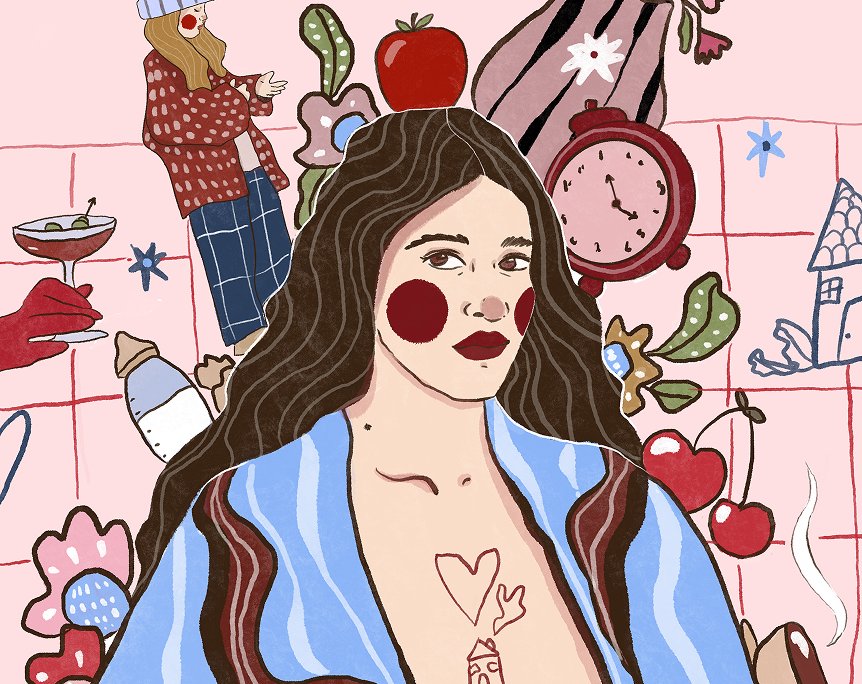
Before there was Rachi Jiménez, there was Raquel, a little girl who spent hours sketching clothes. Her childhood home was filled with paintbrushes, canvases, and art books her mother brought her. Her father was constantly drawing, too. Growing up surrounded by creativity laid the foundation for a career that would eventually move between fashion, portraiture, writing, and the exploration of human emotions.
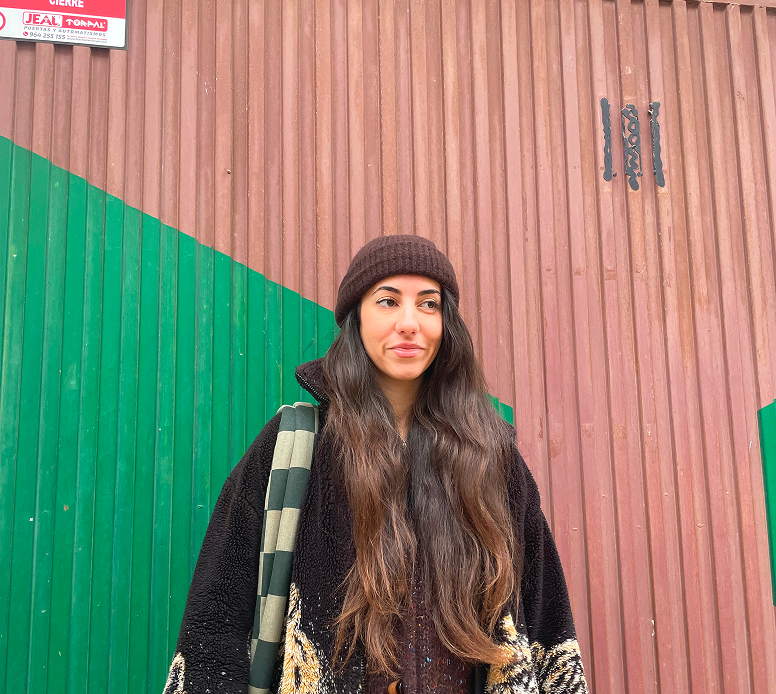
Raquel Jiménez Vallejo, professionally known as Rachi Jiménez, is a Spanish illustrator and author whose early work centered on women, fashion, and portraiture. Over time, her practice expanded from drawing on paper to incorporating digital techniques. Among the early milestones of her career are Como hielo en la arena, a book she wrote and illustrated, and her participation in H&M events in Madrid and Barcelona. What began as an interest in representing women gradually evolved into something more personal: an artistic language shaped by her own experiences and changing sense of identity.
Yet Rachi’s story cannot be told through professional accomplishments alone. Motherhood transformed the way she observes the world, approaches her work, and understands herself. It also led her to question the idealized images through which the experience of becoming a mother is so often portrayed. Today, as she prepares Leche y piel, a project she describes as one of her most vulnerable, she continues to explore what it means to create work that evolves alongside the person behind it.
In this exclusive conversation with Topics That Transform, Rachi Jiménez opens up about her beginnings, the women who inspire her illustrations, the search for an authentic artistic voice, and the complexities of turning creativity into a profession. It is a conversation that begins long before her first professional project and arrives at a question that remains open: how much of the little girl who loved to draw still lives within the artist she has become?
Before Rachi, There Was Raquel
Topics That Transform (TTT): Let’s start at the beginning. Who is Raquel Jiménez Vallejo, and where does she come from? How much of your roots still lives within Rachi Jiménez and the work you create today?
Rachi Jiménez (R.J.): Raquel is the person behind Rachi, and Rachi is a way of seeing life, a way of bringing everything that moves within me down to earth. It is a way of giving light and shadow to motherhood, showing all its sides, and telling the story of what happens to me as I find myself while also navigating motherhood.
I come from a family of artists, and that has shaped the way I express myself since I was very young. A large part of my inner child remains present in the way I see the world and create today. It is a dance between who I was and who I am now.”
TTT: What do you remember about your earliest encounters with drawing? Which people or images from your childhood do you still recognize in the artist you have become?
R.J: Drawing was always close to me. I remember being very young and constantly designing clothes. At home, there were always paintbrushes, canvases, and books about painting that my mother bought for me. My father also played an important role in my journey as an artist. From a very young age, I remember him drawing all the time.
Ultimately, something I have always held on to is how my drawings make you feel, rather than the final result itself. I believe our perspective as artists begins to take shape much earlier than we realize.
Drawing was always a part of my life. I remember being very young and constantly designing clothes. At home, I was always surrounded by brushes, canvases and art books my mother bought for me.
Drawing Women, Discovering Herself
As the years passed, those early illustrations gave way to a more personal artistic exploration. Women, who had been present in her work from the beginning, became more than the subjects of her drawings. They also became a way for Rachi to examine her own identity. The evolution was neither immediate nor straightforward. There were shifts in style, creative blocks, and periods when she questioned the very purpose of what she was making.
TTT: Finding your own artistic voice rarely happens overnight. How did you begin to understand what you wanted to express and, more importantly, how you wanted to express it?
R.J: I believe your own voice develops over time as you try to become more authentic and honest, gradually removing layers along the way until you find your essence and become a channel for others—in my case, other mothers.
Over time, and by accompanying my own personal journey, I have discovered how and what I wanted to communicate through my drawings. I have gone through many phases in my life and in my development as an artist before arriving at what I now feel is my style.
After becoming a mother for the first time, I realized I wanted to portray motherhood in all its dimensions. It was something intuitive and deeply creative, and the result became a kind of medicine for many mothers.
I have experienced creative blocks and moments when I felt that what I was making no longer had meaning. I went from illustrating portraits and fashion to expressing my own experience as a mother.
TTT: Women have been present in your work from the very beginning. Who are these women to you? After so many years of drawing them, what have you discovered about them—and perhaps about yourself?
R.J: Women have always been the foundation of my inspiration, an endless source of creativity. To me, women represent so many things: strength, courage, creativity, muses.
Drawing them became a way of understanding them and understanding myself within my own femininity. Through painting women, I discovered that we are an infinite source of inspiration and creativity, vulnerability, courage, success, and beauty in imperfection.
I learned that there is no single way to be a woman in this world, that being a woman does not mean being perfect or accomplishing something extraordinary, and that making peace with ourselves is the most beautiful way to find who we are.
Between Drawing and the Written Word
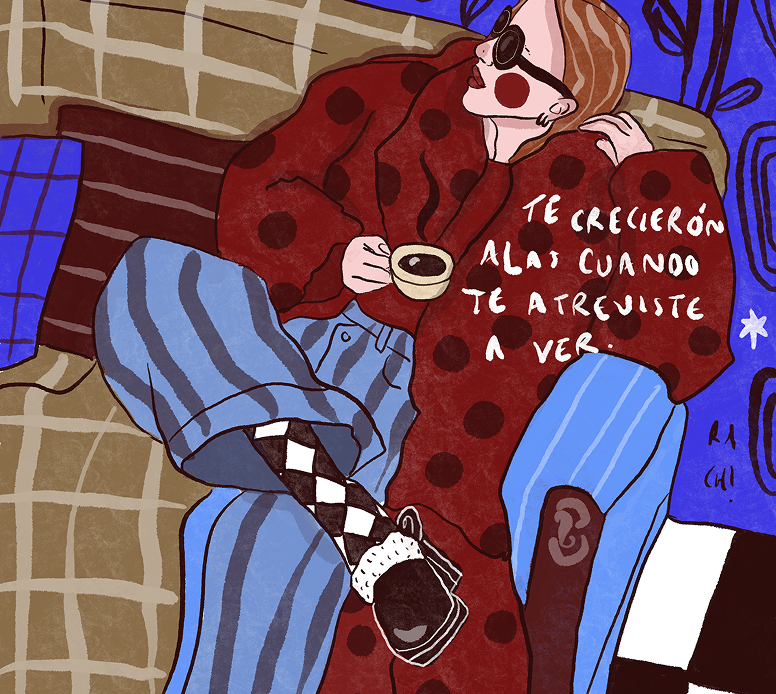
In Rachi’s creative universe, illustrations coexist with words that expand their meaning. Writing is not necessarily a way of explaining an image, but rather of opening it up to new interpretations. For her, a work takes on another dimension when the person looking at it can recognize something of their own story within it.
TTT: Illustration and writing coexist in your work. What can an image communicate that words cannot? And what do you need to put into writing because a drawing alone is not enough?
R.J: Yes, both coexist. Very often, the drawing comes before the words. Drawing helps me give shape and space to what I am feeling, and then the words arrive.
An illustration allows someone to make it their own, to understand it through their personal experience and give it whatever meaning they need. Writing allows me to go further. Finding a balance between the two helps tell a story while still allowing the viewer to make part of it their own.”
TTT: We are surrounded by images, consuming them almost without pause. Amid so much visual noise, what do you believe still has the power to make someone stop and truly look?
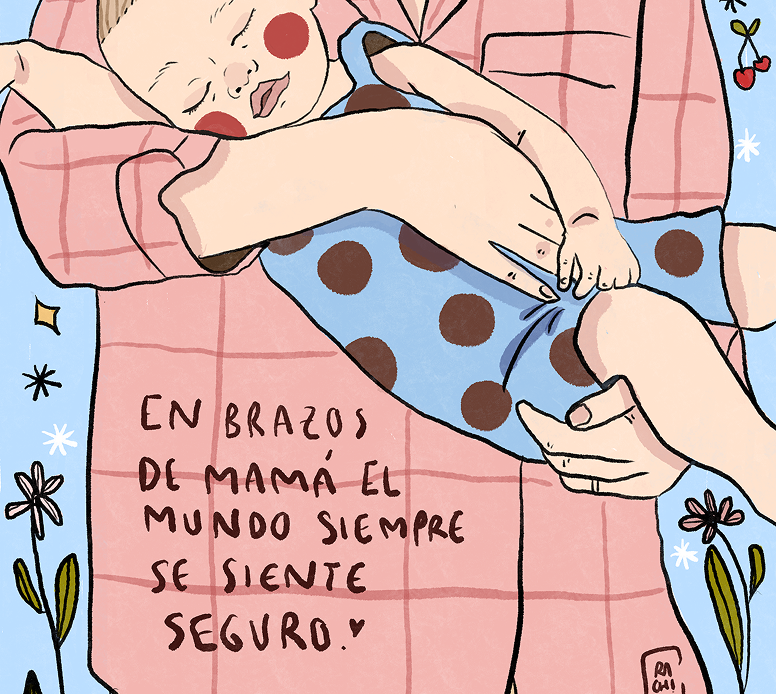
R.J: Without a doubt, I think it is the ability to capture an emotion through a drawing, something that makes the viewer stop and allows them to make that work their own. It is about creating a sense of intimacy between the artist and the viewer.
The Freedom to Create
Turning a passion into a profession means learning to navigate commissions, expectations, and deadlines. For Rachi, collaborations with brands have become part of her professional journey, but they have also reinforced the importance of preserving a recognizable artistic identity. That same concern emerges when she speaks about the need to keep drawing without a commercial purpose.
TTT: Your work has also entered the world of brands and commercial collaborations. What do you look for in a partnership to ensure that you are not simply illustrating someone else’s idea, but genuinely contributing your own perspective?
R.J: It is very important to find common ground between my way of expressing myself and the project itself.
A collaboration works when a brand has something to say and I can find a way to communicate it that still makes sense within my own artistic language.
I like being able to bring something different to a brand, creating an intimate signature and a connection with the audience that allows people to relate to it.
And I also need a certain degree of freedom. When there is trust on both sides, something wonderful can emerge, allowing me to create something that does not feel disconnected from my own work.
TTT: When something as intimate as drawing also becomes your profession, how do you protect the part of yourself that first began creating purely for pleasure?
R.J: I believe it is essential to continue protecting spaces where you can create purely for pleasure.
When art becomes your job, it is important to allow yourself moments of unrestricted expression, so you can return to creating from a more authentic place.
The line between pleasure, self-imposed pressure, and the automation of art is incredibly thin. It is easy to cross over without even realizing it.
Women have always been at the heart of my inspiration, a constant source of creativity. To me, women represent many things: strength, courage, creativity and muses.
Motherhood Beyond the Ideal
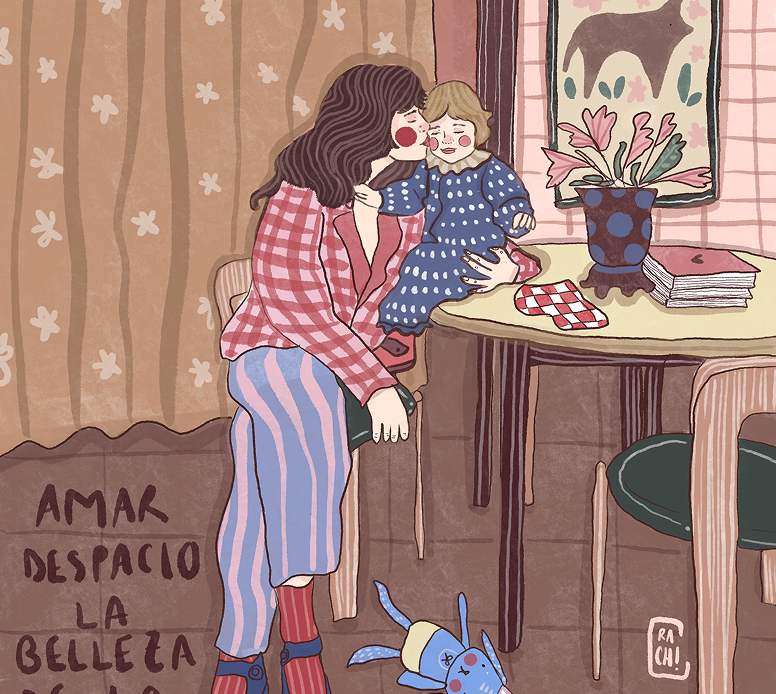
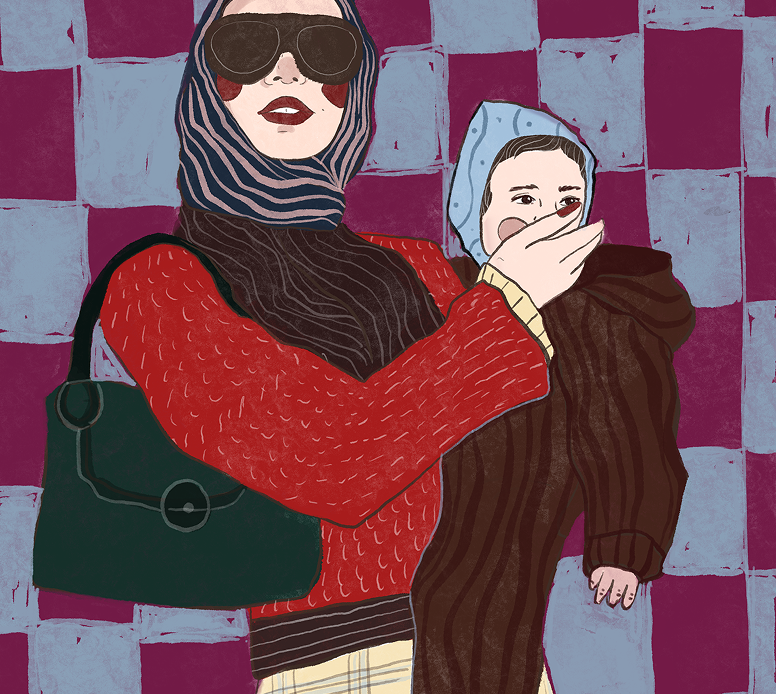
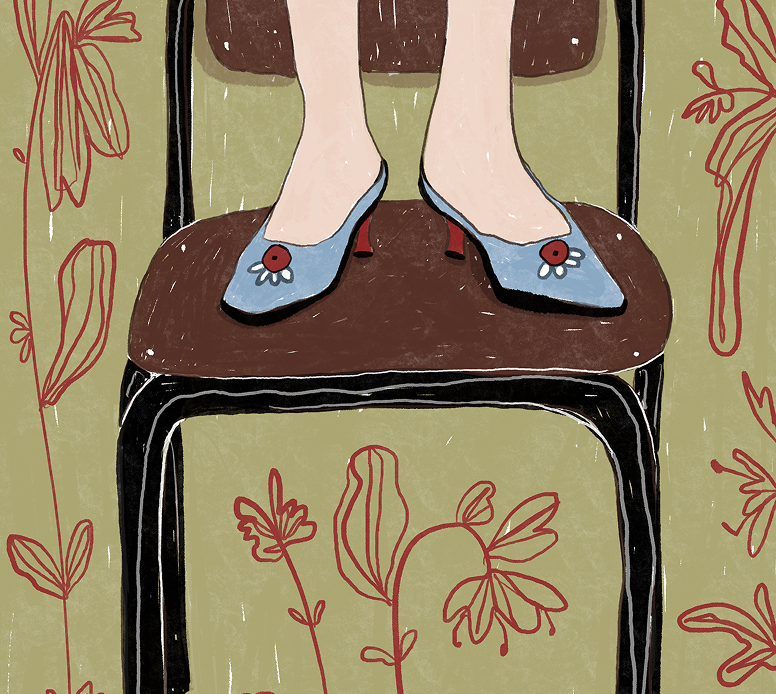
Motherhood marked a significant turning point in Rachi’s work, but also in the way she understands her own life. She began finding inspiration in moments that might once have seemed insignificant, portraying emotions rarely included in conventional representations of motherhood. That perspective eventually led her to revisit classical works of art and consider how much the experience of being a mother has truly changed throughout history.
TTT: Motherhood now occupies an important place in your creative universe. How has becoming a mother changed the way you see the world—not only what you draw, but the things you notice?
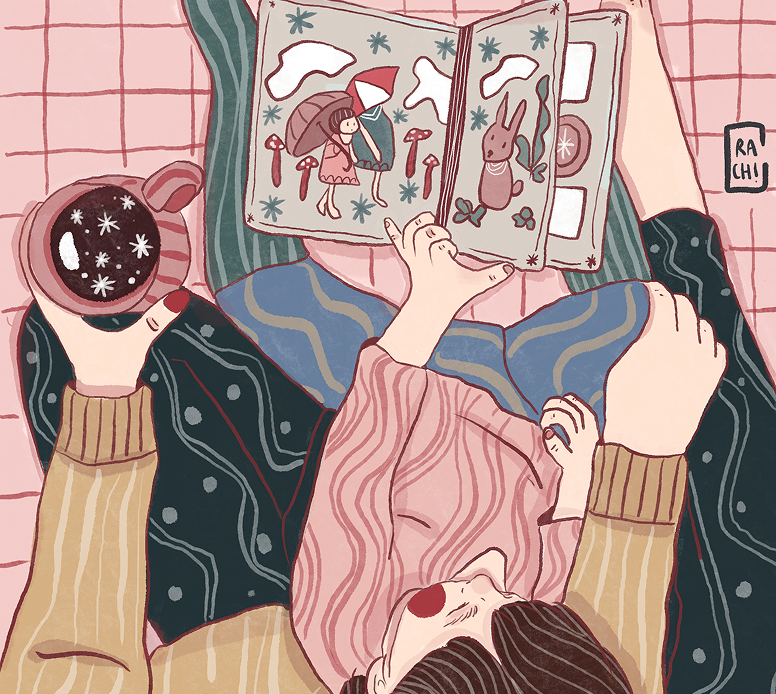
R.J: Motherhood is a very important part of my work as an artist. Ultimately, it is my own journey as a woman that takes shape and naturally begins to blossom and appear in my drawings.
It is my way of telling my story and the stories of many other mothers. Of giving motherhood a voice.
Becoming a mother has taught me to understand life more simply, to recognize beauty in everyday moments. It has taken me down paths I never imagined, made me lose myself and find myself again, and all of this is reflected in my work.
TTT: You have also brought this perspective to representations of motherhood throughout art history. What inspired you to revisit these works through your own visual language? What did you find in those mothers that you still recognize in mothers today?
R.J: Not long ago, I created a collection curated by my representative, Carmen Ballesta, reinterpreting works from art history that portrayed motherhood.
It was her idea, and I thought it was wonderful. It was an opportunity to travel through art history and see motherhood reflected with the same essence, but in a different way.
What I found in those works is something that remains unchanged: a mother’s gaze, the tired eyes of a woman living in a world that does not support mothers, devotion, and love. Some things never change.
Leche y piel: What She Had Yet to Tell
That desire to portray motherhood without idealization finds a new expression in Leche y piel, a project Rachi describes as a dream come true and, at the same time, one of the most vulnerable experiences of her career. Through its pages, she hopes to share her own story while creating a space where other women can recognize emotions that are not always easy to articulate.
TTT: Now comes Leche y piel. What does this project mean to Rachi Jiménez, and where did it begin? What did you need to express here that you had not yet shared?
R.J: Leche y piel is my journey as a mother. It is a dream come true, my most vulnerable side opened up to the world. It is a way of speaking more intimately and with a greater sense of safety. It is about telling my story of motherhood, and that of many other women, far removed from idealized portrayals. I am certain that many mothers will connect with these pages in a deeply personal and meaningful way. Sharing this part of myself fills me with excitement and a sense of vertigo in equal measure.
Leche y piel is my journey as a mother. It is a dream come true, my most vulnerable side opened up to the world. It is a way of speaking from a more intimate and safe place.
The Little Girl Who Never Stopped Drawing
After the projects, collaborations, and personal transformations, Rachi recognizes one constant throughout her story: the desire to keep creating. Her relationship with drawing began long before she had an artistic name, and it remains a way of understanding her experiences, even as she has learned to reveal parts of herself she once preferred to keep hidden.
TTT: If you could bring together the Raquel who first started drawing and the woman creating today, what do you think they would immediately recognize in each other? And what would surprise them most?
R.J: They would recognize the desire to express and communicate everything that lives inside me through drawing. The need to give shape to everything that moves within me. Some things never change, and one of them is the desire to keep creating.
I am sure the Rachi who first began creating would be surprised by everything we have achieved. She would be surprised by how openly we now show ourselves, without being afraid of appearing vulnerable. Back then, with so many layers protecting us, that simply was not possible.
From the little girl who designed clothes surrounded by paintbrushes and art books to the woman who now dares to reveal her most intimate emotions, there is a story that is still far from finished. Rachi Jiménez has found in illustration more than a profession: a language that accompanies her even when words fall short. The subjects, intentions, and meanings of her drawings have evolved, yet they retain the curiosity of someone who continues discovering the world while trying to understand herself. And perhaps the most compelling part of her work is not everything she has learned to draw, but everything she is still willing to reveal.